Showing posts with label birding. Show all posts

Tuesday, 16 May 2017

Sakrebyle Elephant Camp


Published in the 15 March 2017 edition of www.jlrexplore.com, a nature and wildlife-specific website

We were hunched over next to the kitchen building, unmindful of the water dripping over our heads from a water tank which had just overflown, peering in amazement at the gigantic reddish growth in the ground. Was it a flower? A fruit? A vegetable, perhaps? It looked not unlike a cabbage. We had no immediate answers, and the staff said that nothing like this had ever sprouted before. Lying prostrate before the wondrous object, I could see beetles and ants move along the sinuous folds of the reddish bulb, and between the cabbage-like leaves at its base, emerging coated with fine, yellow pollen. I soon discovered that I had seen the flower of an Amorphophallus sp. for the first time.

The Amorphophallus sp. with its pollinators

When I decided to visit Sakrebyle, I had no expectations other than that I wanted to get away from the city for some quiet time. There isn’t much to ‘see’ or ‘do’ in Sakrebyle, and that suited me just fine. A modestly sized campus, this Jungle Lodges’ property is a relative newbie, offering cosy log cabins across the road from Sakrebyle’s famous Elephant Camp. The smallness of the campus ensures that a holiday here is peaceful, barring the bird-calls that resound from bamboo groves at the edge of the property.

Log cabins at the JLR property

Allowing for backyard birding (literally), the property’s bird-bath offers birds some much-sought-after respite from the afternoon sun, while you sit behind a screen and enjoy their antics and birdsong. Even the shy Indian Pitta is said to be a visitor to this bird-bath, as is the Yellow-browed Bulbul, a Western Ghats endemic.

The hide near the bird-bath
Dark-fronted Babblers, which are endemic to the Western Ghats.
The on-campus flora is home to various butterflies, bees, beetles and other insects, and the resident naturalists are only too happy to take you on a nature walk. Some of these nature trails are longer hikes through the surrounding Shettihalli Wildlife Sanctuary, weaving though a mix of dense canopies, shrub-land and grasslands. Along one of these trails, I spotted a lifer, a Drongo-cuckoo, and was engrossed in observing it. The sudden trumpet of an elephant from behind us had me scramble away, briskly walking all the way back to the property. While having breakfast soon after, we saw the elephant emerge from the trail, a mahout astride it, and realised that it was a camp elephant.

A Scimitar Babbler
The trekking trail

The aforementioned ‘Sakrebyle Elephant Camp’ is located across the road from the Jungle Lodges’ property, on the banks of the Tunga River. Housing elephants which have been captured or born in captivity, some of them undergoing treatments for injuries, the elephant camp is fairly popular with visitors to the Shimoga region, especially with children. Watching the pachyderms being scrubbed clean in the river, sometimes playfully squirting their mahouts, I was left to deal with mixed emotions. However, understanding that matters cannot be looked at as starkly black or white, I ambled around the small camp, watching visitors interact with the elephants, sometimes apprehensive, but then, reassured by the mahouts, always enjoying the experience.

Elephants being bathed by their mahouts


Having emerged from the river, the elephants were now being oiled to keep them cool, even as their food was being prepared. They are fed in an interesting way – chunks of coconut flesh and jaggery are wrapped into a bundle using hay, which the giants gleefully devour. A few of the youngest elephants were play-fighting and chasing each other, only to be firmly nudged by an adult if they got too boisterous.


With this playful sight as my parting memory, as I turned to leave, a loud trumpet from one of the young elephants made me jump a little. Just as an elephant’s trumpet had marked the beginning of my trip to Sakrebyle, this trumpet signalled the end of my short but memorable time in the land of elephants.

Sunday, 1 November 2015

Wild Postcards from Sri Lanka


An unedited version of my story published in the November 2015 edition of the in-flight magazine, JetWings


I furrow my brows, as the ringtone interrupts my hectic deadline. The number displayed on my mobile is unknown, but I continue to stare – something about it beginning with +94 seems deliciously familiar. I answer. Silence. Just as I return to furiously typing out the remainder of my email, it rings again. I absently answer the call, only to be greeted by rapid-fire talk in a language I don’t understand. Then it comes back to me, rusty as the memory is, from months of disuse. I get up from my chair, smile at no one in particular, and say “ayubowan.” The relentless chatter pauses. “No Sinhala,” I continue, like I’d repeated for three weeks, many months ago. The voice begins talking in an endearingly halting and lilting Hindi, “Main Prasanna bol rahaa hoon.” I can hear a smile, a shy smile. “Aapka letter aaya.” Instantly, my deadline is all but forgotten.

Sinharaja Forest Reserve, in south-west Sri Lanka, is the country’s only surviving primary tropical rainforest. Its pin-head size belies the fact that more than 60% of the flora and fauna found here are endemic to the region. Due to this high endemism, the forest has been declared a UNESCO heritage site.


Prasanna was my eyes and ears in Sinharaja, where the earth was as slippery as grease, and battalions of leeches clung to every human who dared brave the incessant rains. The sky flickered between innumerable shades of grey, and could barely be glimpsed through small gaps in the tall, dense rainforest canopy. The highlight of my trek was witnessing a mixed-flock hunt, with raucous drongos, frisky babblers, belligerent Blue Magpies, and even the dignified trogon, feasting on worms and insects emerging from the rain-battered earth. The forest trail yielded birds, fungi, flowers, snakes, and lizards of such varieties, that we were constantly surprised at every turn; even the endangered Purple-faced Leaf Monkey revealed itself on my last evening at Sinharaja.


At the end of each tiring day in the forest, I’d return to my room at Martin’s Simple Lodge, a place which is exactly as its name suggests, swapping sightings and experiences with fellow birding enthusiasts while savouring refreshing tea on the terrace overlooking Sinharaja’s dipterocarps, or while nonchalantly plucking leeches off our persons by the communal tap. The owner, a former guide and a wealth of information, is a man of few words; what makes him smile though, is visitors’ childlike enthusiasm at having seen a Red-faced Malkoha or a Ceylon Frogmouth up-close, in the forest he holds dear.


"Sinharaja’s villages don’t have pin-codes; how will my letter be delivered?" I’d asked, while saying goodbye. Prasanna just smiled, answerless. I needn’t have worried: the letter, along with photographs of Sinharaja, had reached him within a week of my convincing my neighbourhood post office that I was not ‘wasting eighty rupees in postage’.

“There is an error in your identification” Prasanna says, alluding to the contents of my letter, “This is a Purple-faced Leaf Monkey, not a Bear Monkey.” I apologise sheepishly for my rookie mistake. The mention of the Bear Monkey, though, swings me along to another place, another day.

Horton Plains National Park, located in Sri Lanka’s central highlands, is the country’s only montane grassland and cloud forest. Due to its high elevation, fog and clouds deposit a large amount of moisture, creating a unique ecosystem of moist grasslands, swamps and wetlands. The endemic flora and fauna have evolved to suit this peculiar habitat. Ohiya is a convenient base for exploring Horton Plains. However, due to extremely limited accommodation here, most visitors prefer to stay at the popular hill station Nuwara Eliya, almost two hours away.


The mountain railway at Ohiya snakes through dense foliage, from which peek colourful tin roofs. An occasional curlicue of smoke from a cooking fire is the only sign of habitation. Hiking along the tracks brought well-preserved, century-old sleepers and metal components my way. I was also rewarded with an encounter with the endemic Bear Monkeys, cousins of the species in Sinharaja. Over twenty of them, jumping from branch to branch, with a wary eye on me, looking improbably like monkeys with bear ancestors - to think, I wasn’t even within the national park boundary yet!


At Horton Plains National Park, the 9 kilometre trail meandering across grasslands, seasonal ponds, over undulating rock, sometimes gravel, and finally through dense forest, can be completed in 3 hours. However, stopping to admire bright orchids and gnarly trees, while looking for Bear Monkeys and elusive birds, meant that my trekking time doubled. My guide and I trekked anti-clockwise, beginning at the grasslands, moving on to Baker’s Falls, Large and Little World’s Ends, and finally, through dense vegetation. 

Old-man’s beard, a characteristic of Horton Plains, festooned all the trees in the last stretch, whose trunks and branches were also decorated with lichen and moss. A Sri Lankan breakfast of rotti, jam, and bananas, devoured while staring into World’s End, added to the air of fulfillment and quiet contemplation; the sheer escarpment here offers views till the coastline, on one of the rare clear days like that day.

I sigh, looking at the digital clock on my computer screen. The sun has long set, and I’ve been caught up in Sinharaja and Horton Plains. A flick of the switch illuminates the room. The paperwork on my desk lies un-tackled, held down by a pebble, smooth and rounded, as grey as the sea was that day. With white specks, as white as the sand looked, reflecting the sun’s generosity beating down on it. There I go again, carried along by a wave of memories.


Mirissa, a tiny fishing village in southern Sri Lanka, attracts visitors for two reasons: its laidback, picturesque beach and its whale-watching trips. Since it lies at the southernmost tip of the entire Indian subcontinent, whales migrating east to west must cross Mirissa. The abundance of food in the Indian Ocean makes it a favourite with these cetaceans, and even the otherwise-elusive Blue Whales and Sperm Whales are routinely spotted.  


At 5:30 am one morning, travellers gathered at the whale-watching agency’s office, upbeat at the prospect of guaranteed sightings of whales and dolphins. I, however, couldn’t bring myself to ignore the knot in my stomach, as I don’t take well to open seas. On the two-decked boat, all around me was laughter, anticipation and colourful life-jackets. The tantalising omelette station on board was crowded; just an hour later, the boat’s only restroom would be; so too the railing on the deck, with nauseous travellers bent over. Despite having resolutely stayed away from breakfast, I could feel my innards churning - quite an indication of the roiling Indian Ocean.

By the time we returned to shore after six hours at sea, we had become a statistic – the only boat in forty days to not sight a single whale. I held on to precious, fleeting memories of the dolphin pod we had seen, unfortunately far enough to look merely like grey flotsam. The next afternoon, travellers were agog at having spotted multiple whales. One had even breached the water, excited voices told us. All I could do was close my eyes and picture it, the waves lashing Mirissa’s beach adding sound to my thought. I smiled, as my imaginary Blue Whale emerged from bluer waters, magnificence personified. For this, I will brave the Indian Ocean again someday, I decided, sanguinely.   

“Wapas aaoge tab milenge” is Prasanna’s parting shot. He knows Sri Lanka’s allure – you just MUST return.  Sometimes, that’s all it takes to travel in time – a call you hesitated to take.


Tuesday, 2 December 2014

A River Runs Through It


Published in the 01 Dec 2014 edition of www.jlrexplore.com, a nature and wildlife-specific website.


Nanjaraja, the king of Nanjarayapatna, had many enemies. In a dream, he was told that his troubles would vanish if he built a temple in a day. The task seemed impossible, but if anybody had a chance of doing it, it was the masterful Chola architects. They were pressed into service and set about achieving the deadline, working through the night. An errant rooster crowed earlier than usual, and the Chola builders left, assuming it was daybreak. A bridge - presumably across the river Cauvery - remained unfinished. Nobody knows if Nanjaraja’s fortunes reversed.

Fast forward five hundred years - Tipu Sultan’s pillaging army found neither gold nor gems in that temple, known as Veerabhadreshwara temple. Uninterested, they left it half-destroyed, saying “We’ll return another time to do this”, or, “We’ll come dubara”, giving Dubare forest its name.

The ruins of Veerabhadreshwara temple on the road leading to Dubare

A couple of centuries after Tipu Sultan, I packed my suitcase with equal disinterest; I threw in a few long-pending books, confident of finishing them that weekend. Being a seasoned, four-prior-holidays-in-Coorg veteran was reason enough for me to have my nose up in the air - I’d already had a ‘stay in a home-stay’ holiday; I was also done with my ‘pamper yourself in one of Coorg’s resorts’ holiday; I’d also had the rather rare ‘stay with your coffee plantation owner friend’ weekend. All the famous sights had already been seen – Bylakuppe, Abbey falls, Raja’s seat, Omkareshwara temple, elephant bathing at Dubare, Talacauvery. Why, I’d been on a trekking holiday to Thadiyandamol too. I sighed, kicking myself for not planning to go to a new destination.

Of course, lying around reading books with an endless supply of coffee can never be too bad, I consoled myself. My other-half (henceforth OH) had no such motivations for returning to Coorg; he staunchly refused to join me. I unabashedly lied to him, promising we’d spend all three days exploring facets of Coorg we’d never seen before. As we waited by the Cauvery on the bank opposite the Dubare Elephant Camp, for the Jungle Lodges’ boat to pick us up, I wondered how much time I had before my deception was exposed.

The landing dock at JLR Dubare, by the Cauvery

Three days later, OH gently steers our car over a bad stretch of road, to prevent the cheap liquor bottles filled to the brim with luscious Coorgi honey from clanging into each other and breaking. I glance at him for a ‘holiday indicator’ expression that is usually writ large at the end of each trip - a broad grin is plastered over his face.


Me: Enjoyed breakfast today, huh? You’re smiling.

OH: Yeah, the neer dosas were melt-in-your-mouth. And, I’m going to miss this coffee! (glaring at a honking car and frowning) Well, we better get used to our return to the urban jungle.

Me: So you’re glad you tagged along? You almost didn’t!

OH: I frankly didn’t expect the cottages at the JLR property to be set by a peaceful side of the river. I was half-expecting screaming crowds - bathing elephants or boating - right outside my room.

Me: I agree; this was a pleasant surprise. And who knew the forest began in their backyard! I was more thrilled with our morning walks than the jeep safaris, though. Once Putta Naik reassured me about being on foot in elephant territory, the plants, spiders, damselflies and other critters had my undivided attention. I’ve never spent ten minutes watching a spider spin its web!

A nature walk in Dubare, with the river for company

OH: (braking suddenly) We’re almost at the turnoff to Chiklihole…are you sure you don’t want to check if the view today is better?

Chiklihole, a reservoir, is one of Dubare’s little-known secrets. When we’d visited the day before, the weather had been moody. The water was a still, lacklustre sheet, with a mist-covered backdrop. The grey monotone of both the sky and the reservoir offset the vivid colours of the fishing coracles - not your quintessential picture-postcard vista, but, dramatic enough to command attention. The clouds, unfortunately, decided to deny us the spectacular sunset the locals had raved about. I could have spent many hours shooting the breeze, seated on the coarse stones of the humongous embankment, except, OH had dragged me away. For a good cause, though; I would have missed the fish auction if he hadn’t. Grown men running at break-neck speed, all for snapping up some fish, is not an everyday sight. At one point, two men almost got into blows over a beauty; egged on by their respective friends, they persisted for many minutes, until the fishermen intervened to seal the deal.

Fishermen and their fishing coracles, at Chiklihole reservoir


OH: (recollecting the fish-war) The locals sure seem to love their fish!

Me: Fish, and spices! Remember, Harsha showed us those deceptively small Gandhari chillies in his plantation? He was horrified when I said I wanted to taste one; he quietly steered me away from those bushes.

OH: (laughing) You would have been blinded like Gandhari, had you eaten one. I’m glad you forced me to visit a plantation – I feel like a pro, being able to tell the difference between Arabica and Robusta.

Coffee beans, in various stages of drying

Not only was OH happy, spurred by Harsha (our guide), he had even plucked fresh pepper, vowing to make some pickle once home. Harsha and his family invest a lot of time and energy looking after their coffee plantation, like many Kodavas do.  It isn’t easy, despite having sprinklers for watering the plants. Keeping them pest-free and harvesting the beans when just right is hard work. Not all creatures are pests, though; their plantation is home to a host of critters which are welcome – we spotted giant wood-spiders and well-camouflaged toads too.

Camouflaged toad in the coffee plantation

Me: Until Harsha told me, I didn’t know that spiders were such an integral part of coffee plantations.

OH: For that matter, wildlife seems so inseparable from Coorg. Even if you are not looking for wildlife, it finds you. Like when you saw an Indrella ampulla on the compound wall of a devara kadu.

Me: Or when I narrowly missed stepping over the bracket fungi in the devara kadu at Chettalli. I’m so happy we could see a few of these sacred groves.

I hadn’t known about devara kadus until I read an article some months ago. These forest patches have survived the onslaught of development, as sacred groves. Some remain in their primal form under trees, while others are being ‘developed’, with small temple-like structures being built. This trip had allowed me to peek into this spiritual side of life in Coorg.

Bracket fungi and a stream, in a devara kadu by the road, at Chettalli

OH: The next time we visit, we must time it to witness ritual dances at these devara kadus.  Or probably visit in March, when the grand puja is conducted at the Veerabhadreshwara temple - with priests coming from all over Karnataka, it promises to be festive.

Me: I wouldn’t mind another visit. I still need to experiment with photographing star trails. I am unhappy with the results this time, but we should get clear skies once this monsoon passes. You really missed experiencing midnight by the river!

I had spent many hours at night waiting by the river, hoping for the skies to clear. The riverside took on a different character, as the cobalt blue of dusk slowly turned inky. With people tucked away in their homes and hotels, a permeating silence descended on the Cauvery - one that allowed me to hear the gentle sloshing of the currents. Curious to see how the transformation progressed, I awoke at 2 am, only to find the landscape mist-covered and eerily beautiful, bathed in bluish-white moonlight. Though it felt too spooky for a walk, the cottage’s balcony had been perfect to lounge in, at that time.


River-side cottages at JLR Dubare

OH: (smiling) I may have had the energy to wake up in the middle of the night, if I hadn’t spent all evening chasing you around Madikeri’s buildings. You architects are magnetically attracted to buildings, aren’t you?

Me: (embarrassed and defensive) You enjoyed those monuments as much as I did! The Madikeri fort’s upkeep is a little disappointing, but walking on the moss-covered ramparts, taking in the town’s views, made up for it. Very few visitors seem to enjoy it, though.

OH: And even fewer visit Gaddige. The tombs may be decrepit, but their location is beautiful. So is some of the architectural detailing.

Moss-covered Madikeri Fort

Kings’ tombs, called ‘Gaddige’, set on an elevated patch of land in the middle of bustling Madikeri

Me: (laughing) Spoken like an architect’s husband! If only I were born a century ago, we could have lived in a gorgeous ‘Ain Mane’. We were lucky to even stumble upon one of these ancestral houses – most have been demolished to make way for newer homes.

A typical Kodava ‘Ain Mane’

Unlike Tipu’s demolishing soldiers who never returned, OH sheepishly agrees that Coorg definitely merits repeat visits. He still needs to ride down the Cauvery in a coracle. And, Putta Naik, our naturalist, has promised to show us many more critters and interesting insect-behaviour within the Jungle Lodges property.

A leaf-hopper, seen during a nature walk

I, however, had ended my holiday floating in a coracle amidst cheery, bright water lilies, past the resort’s gol-ghar, waving to OH, who had opted for a head start on breakfast. There, in that coracle, I reminded myself - even as a by-now-five-holiday veteran, I have more to seek out in Coorg, if I do come, ‘dubare’.

P.S: My books did not see the outside of my suitcase. Coorg had had the last laugh.

Water lilies and a dragonfly


Tuesday, 15 October 2013

Bhadra: Still Water | Still Mind


Published in the inaugural edition of www.jlrexplore.com, a nature and wildlife-specific website

I'm in a balcony overlooking the heaving sea, one rainy day; the breeze is forcing the trees to bend over in obeisance to the monsoon and the sea responds with booming gun-salutes as waves crash over the shore. Yours truly is seated on the floor, with the breeze sending a few stray drops her way. Writing about Bhadra, in Karnataka, is proving to be more difficult than I thought - how do you describe a place that defies typical descriptions? In a way, the experience there too is about the water and the trees, like the scene playing out before me right now. Yet, it is a whole world away.

Picture what you know about these: reservoirs, islands, rooms with views, bridges, forests, birds and animals. You can expect all this at Bhadra, but not quite in the way you know it. 
From the highway, as you drive towards the government-owned River Tern Lodge, the only accommodation at Bhadra, the panorama may seem insipid. But, to experience Bhadra is like unravelling a gift wrapped in many layers - it progressively makes you fall for it.


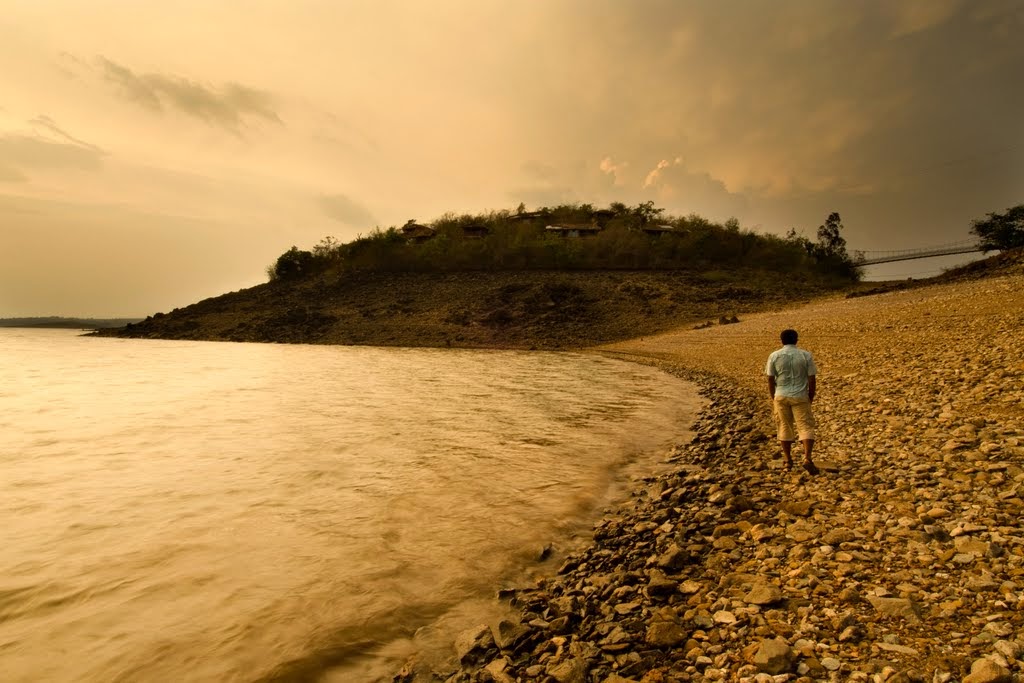
You walk through the entrance, past the reception, along a path and down a long flight of steps. This is where you will take the first of many pauses. Before you appears the beginnings of a suspension bridge; your pace quickens. Soon, you will pause again; you realise that the bridge leads to an island and both are tantalisingly surrounded by water. You trot across the bridge, only to pause yet again, to realise that you are actually in the middle of the reservoir. By the time you climb up to your room and go to its balcony, the scale of the reservoir dawns upon you. This is where you will pause the longest, before reluctantly returning to your room.


The suspension bridge connecting the island to the mainland is a gateway to solitude.


The cottages on the island may be a long walk away, but, staying there makes you feel like you are the lone resident of the island.

I might sound presumptuous in pointing out exactly where you will pause. Also, I confidently say 'will' pause and not 'may' pause, only because no matter how many times you go to Bhadra, you will stop and look. By the time you've spent the day lounging on the balcony, napped in the afternoon looking at the reservoir and sat ensconced under a starry night sky, you are a convert. You will definitely be drawn to Bhadra again and each time you visit, you will be shown something new. 


The balconies at Bhadra command panoramic views of the reservoir and are some of the most soothing spaces to lounge in.

This is how I slowly discovered that in some cottages, you can bathe in the company of birds outside your window. In yet others, Red Spurfowl stand in front of the window pane, admiring their reflection or mistaking it for a threat. Some seasons, the reservoir is calm, as all reservoirs should be. At other times, you can constantly hear waves lap against the shore. I discovered how evenings can cloak everything in myriad hues. And, how you can be right in the midst of this giant paint-brush by walking down to the reservoir's edge. I also learnt how strong the currents in the deceptively gentle-looking reservoir can be. And, how it can sometimes rock the boat enough to drench you during a safari.


Sunsets by the reservoir display an ever-changing colour palette.


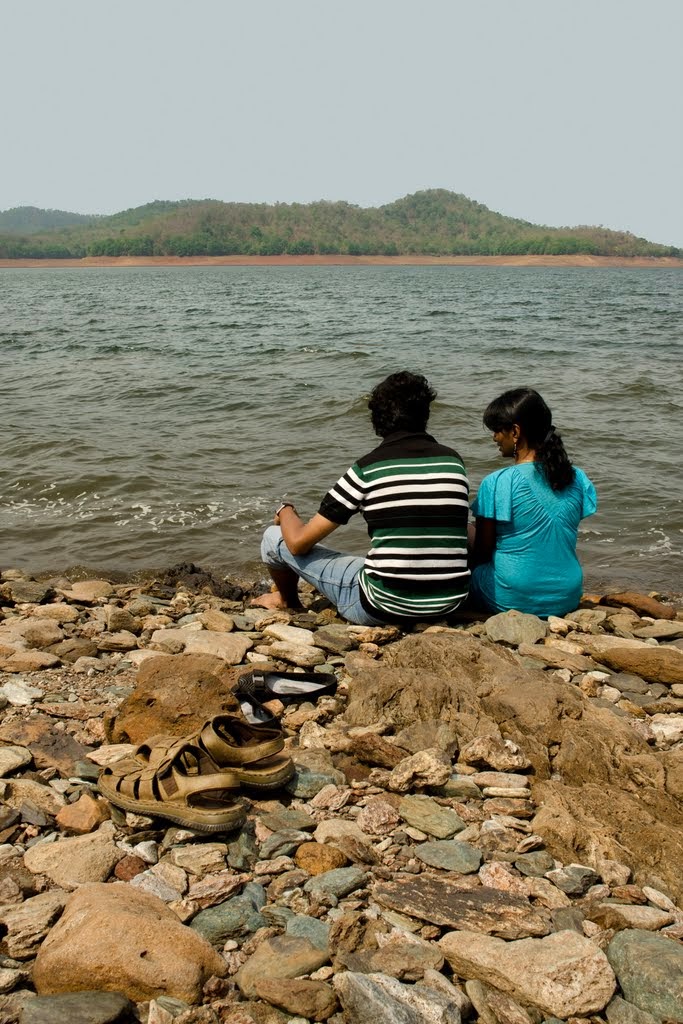
The reservoir’s edge is a soothing place for uninterrupted conversation with somebody. Or, for conversations with your inner-self.


My favourite way to experience Bhadra is through the water and all the life it supports. Boat safaris along the forest edge and around the islands reveal a huge diversity of bird and mammal life. Unique to Bhadra is the congregation of thousands of River Terns on some islands, during their breeding and nesting season from March to May. Raucous, belligerent and fiercely protective of their food and territory, terns can keep you entertained with their antics for hours on end. Especially hilarious is to see them seemingly wash the fish they catch before eating it. Jeep safaris through the predominantly Hunal forest offer an experience quite different from the boat safaris. In winter, these Hunal trees lend a deep-red patina to the otherwise green forest. The chance to spot the melanistic leopard, more famously known as the 'Black Panther', often keeps guests at the edge of their seat.


A boat safari along the fringes of the forest offers a chance to sight many of the birds and mammals which call Bhadra home.


Hyperactive terns against a backdrop of the dam and the reservoir, at sunrise.

At the end of the day, after you return from the safaris, it's time for quiet contemplation. With very few lights lit, your auditory senses are heightened. You can now hear all that you saw - the crunching of the leaves as you make your way along the path, a rustle as something darts across, the creak of the bridge as you cross it, the howl of the wind which rocks the bridge, the lapping of waves at the shore, the relentless drone of Cicadas, and, a voice in your head telling you how Bhadra feels like it belongs to you. And, how you effortlessly feel like you belong to Bhadra. With this thought, you will end your day where I began - in a balcony. Only this time, at Bhadra.